Shimla
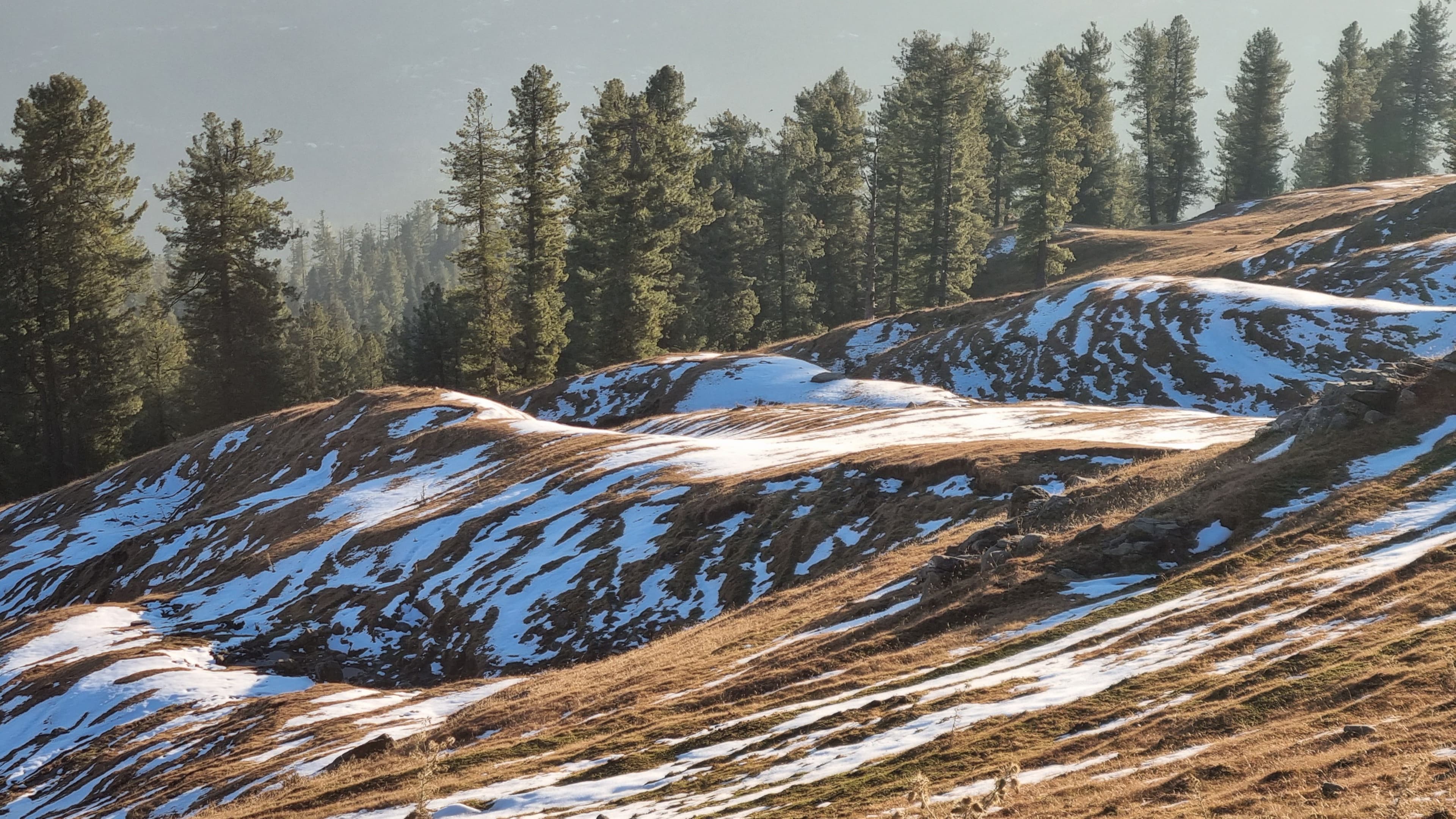
The forested middle Himalayas around Shimla district, extending into orchard country, ridge settlements and quieter slopes beyond the main hill-station circuit.
Shimla is usually reduced to the capital, the Ridge and the crowded roads around Kufri. The district is far larger and more varied. It stretches from the urban hills around Shimla town into forested ridges, orchard valleys, river basins, remote mountain settlements and high passes toward the eastern edge of Himachal.
The landscape changes markedly across the district: from Mashobra, Naldehra and the upper Shimla hills to Theog and Kotkhai; from Jubbal, Rohru and the Pabbar valley to Chanshal and Dodra-Kwar; from the forests of Chopal and Kupvi to the Sutlej-facing country around Rampur, Nankhari, Kumarsain and Narkanda. Shimla should be understood as a collection of distinct mountain regions, not a single hill-station experience. The district’s elevation ranges widely, and its terrain is officially described as rugged and difficult.
Thach chose Shimla because the district contains an unusual range of landscapes and settlement types within one broad region. Beyond the familiar urban circuit are working orchard valleys, forest villages, old mountain homes, isolated ridges and routes into some of Himachal’s least casually visited areas.
It also offers a practical starting point for the collection. Some areas are accessible enough for shorter stays, while others require long drives, seasonal planning or a final approach on foot. That range allows Thach to find stays with real character without treating remoteness as the only measure of distinction.
Know before you go
The land and its people
Shimla district spans a broad section of the middle Himalayas, with elevations ranging from low river valleys to high mountain terrain. Steep ridges, deeply cut valleys and extensive forest systems shape much of the district. Cedar, fir, pine, oak and rhododendron appear across different elevations, while terraces, orchards and cultivated slopes occupy settled areas.
Settlement across Shimla district is uneven and highly dispersed.
Shimla town is dense, urban and institutionally important as the state capital. Around it are expanding roadside settlements, residential hillsides and heavily visited satellite destinations. Farther east and north, the district becomes a network of small market towns, panchayat villages, orchard estates, traditional settlements and isolated homes spread across steep slopes.
Rohru, Rampur, Theog, Jubbal and Narkanda function as regional service centres, while many surrounding villages remain tied to agriculture, horticulture, forestry and local trade. In remote areas such as Dodra-Kwar or the upper Pabbar country, distance and seasonal access still strongly shape everyday life. The district administration itself divides Shimla into multiple subdivisions and blocks, reflecting how geographically fragmented it is.
Shimla district does not have one uniform local culture. Its communities are shaped by different valleys, trade routes, agricultural systems and historical influences.
Shimla town carries the visible legacy of British-era administration, education and architecture. Outside the city, village life is more closely connected to horticulture, terraced farming, forest resources, local deities, seasonal fairs and extended family networks. Apple cultivation has transformed large parts of Kotkhai, Jubbal, Rohru, Kumarsain and the Narkanda–Kotgarh belt, influencing incomes, architecture, road development and seasonal labour.
The eastern and upper parts of the district also retain strong valley-specific identities. Food, dialect, temple traditions and building practices vary considerably between the Sutlej basin, the Pabbar valley, Chopal, Dodra-Kwar and the central Shimla hills.
When to come
Spring and autumn offer the most balanced conditions across much of the district. Summer is accessible but busy around established destinations. Monsoon travel requires flexibility because landslides, fog and road disruption are common risks. Winter brings snow to higher ridges, while access to remote valleys and passes becomes highly variable.
High around Shimla city and established road-accessible destinations; moderate across orchard towns and the Pabbar valley; generally low but environmentally sensitive in remote areas such as Chopal, Chanshal and Dodra-Kwar.
Being there
Shimla district is too large for a single short visit.
Stay for three to five nights within one chosen part of the district. Do not try to combine Shimla town, Rohru, Chanshal, Rampur and Narkanda in one hurried circuit.
Possible slow-travel bases include:
upper Shimla hills for forests and shorter access
Kotkhai or Jubbal for orchard country
Rohru or Chirgaon for the Pabbar valley
Narkanda, Kotgarh or Thanedar for ridge and orchard stays
Chopal for quieter forest country
Rampur or Nankhari for the Sutlej side
Dodra-Kwar only as a separately planned remote journey
Walks vary from short forest paths to full-day routes and high-altitude crossings.
Around Shimla, Mashobra and Naldehra, quieter forest roads and village paths offer accessible walking. The Narkanda–Hatu route provides a more sustained forest ascent. Rohru and Chirgaon form gateways to the upper Pabbar valley, while Chanshal and Dodra-Kwar offer more remote high-country routes requiring careful local verification.
Walking should always be described at the child-place or trail level. A route near Naldehra should not carry the same guidance as a route near Chanshal. Official tourism material notes that Hatu Peak can be reached by road but that the forest walk from Narkanda offers the stronger experience
Food varies across the district, but the strongest experience is usually found in homes, small dhabas and locally run stays rather than destination restaurants.
Look for seasonal vegetables, lentils, rajma, local grains, siddu, breads, pickles, ghee, dairy and orchard produce. Apples, stone fruit and preserves are especially relevant across the horticultural belts. In village homes, meals may reflect local temple traditions, agricultural seasons and family recipes rather than a standardised “Himachali thali.”
Outside Shimla town and larger market centres, travellers should confirm meal arrangements with their stay. Remote areas may have very limited independent dining options.
Observe how the district changes as roads move away from Shimla town.
Notice the contrast between dense urban hillsides and dispersed village settlement; between cedar forest, orchard slopes and high alpine terrain; and between heavily visited roadside destinations and valleys where tourism remains secondary to farming or local trade.
In orchard areas, pay attention to pruning, flowering, harvesting and packing as seasonal work rather than treating orchards as decorative scenery. In the Pabbar valley and remote eastern areas, observe how river systems, snow, road access and distance shape settlement. Across the district, note traditional timber construction where it survives alongside rapid concrete development.
Avoid treating Shimla district as a collection of quick sightseeing stops.
Avoid peak-hour drives through Shimla, Kufri and snowfall corridors when possible. Do not assume remote roads are open merely because a destination appears close on a map. Avoid entering working orchards, forests, temple spaces or village paths without permission or local guidance.
Do not promote fragile areas as “undiscovered” or encourage unprepared driving toward Chanshal, Dodra-Kwar or remote Pabbar settlements. Avoid stays that rely on scenic location while operating like large roadside hotels or disrupting the surrounding village.
Choose one part of the district and stay longer rather than driving continuously between distant areas. Use local drivers on unfamiliar or seasonally difficult roads. Confirm weather, road condition, parking and the final approach directly with the host.
Ask before entering orchards, photographing people or attending local ceremonies. Carry waste back from walks and remote areas. Keep noise low in village stays and avoid blocking narrow roads used by residents, buses and agricultural vehicles.
In water-stressed or high-pressure areas, be conservative with water, heating and waste. A secluded-looking property may still depend on limited local infrastructure.
Getting there
Shimla for the central and western district; Chandigarh may be the more practical major air and rail gateway for travellers arriving from outside Himachal.
In short
No perches here yet
We're still walking this ground. Join the list and we'll write the day the first one opens.
Village clusters